THE CLOTFELTER LAB @ AMHERST COLLEGE


LAB NEWS

July 2026
Collaborative PNAS paper published
Conor Taff at Cornell University led a large collaborative project on tree swallow breeding phenology entitled "Divergent population trajectories despite similar response to temperature in a widespread aerial insectivore," which was published recently in the Proceedings of the National Academy of Sciences. The team analyzed 1,555 population-years from 123 breeding populations of tree swallows -- including the Amherst population monitored by the Clotfelter lab -- and found that populations responded similarly to local temperature variation, advancing their egg-laying date by one day per degree of warming. Northern latitudes, where climate change has been most severe, have seen the greatest acceleration of egg laying over the past 50 years, and the steepest decline in tree swallow breeding populations.

October 2025
Collaborations with Rosvall lab published
The Clotfelter lab contributed data to two publications recently, both led by members of Kim Rosvall's lab at Indiana University. In March of 2024, Dr. Sarah Wolf et al. showed in the Journal of Animal Ecology that geographic variation in telomere regulatory proteins (shelterins) may be responsible for life history variation among tree swallow populations. In October 2025, Dr. Mary Woodruff et al. investigated geographic variation in heat shock proteins in tree swallows across a latitudinal gradient. This work was published in Frontiers in Physiology as part of a special section on avian responses to climate change.
_tif.png)
July 2024
New paper led by Luis de Pablo '23E
We published a new paper on the hydrodynamics of the crayfish escape response in Integrative Organismal Biology! The project was led by former thesis student Luis de Pablo '23E and graduate student Adrian Carleton from the Fluid-Structure Interaction Lab at the University of Massachusetts, Amherst. Using particle image velocimetry we found that vortex formation (as well as force generation) was similar in animals held varying distances from substrate. Thus, there was no evidence of a hydrodynamic boost from ground effects. We did, however, find differences in vortex formation between tethered and free-swimming crayfish. Luis is currently a doctoral student in the Dee Lab in the Department of Ecology and Evolution at CU Boulder
March 2024
Sam Rothberg '21 publishes new paper in Animal Behaviour

Samantha Rothberg '21, along with Ethan Clotfelter and Sarah Wolf (Indiana University), published the results of her senior thesis research in Animal Behaviour. Sam used social network analysis to test the hypothesis that winter flocks of chickadees are more closely connected on cold days than warm days, presumably due to the need to share information about food resources. Spoiler alert: her results didn't conform to expectations, so check out the paper!
August 2023
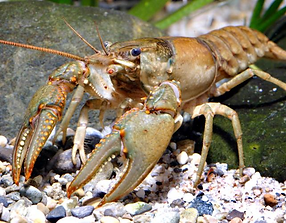
Derek Benson '21 publishes senior thesis work
Derek Benson '21 and Ethan Clotfelter were co-authors on the paper entitled "Size, but not sex, predicts pinch force and exoskeleton mechanical properties in crayfish of the genus Faxonius" published recently in the journal Invetebrate Biology. Derek investigated the potential for sexual dimorphism in the material properties of structures used in combat and display, namely the major chelae of freshwater crayfish. Derek is now a 3rd year graduate student at Arizona State University, studying the physiological ecology of rattlesnakes.
(Photo credit: Missouri Department of Conservation)
.jpg)
March 2023
New lab paper in Ecology & Evolution
Ethan Clotfelter and Sam Zhang '21 are co-authors, along with lead author Sarah Wolf, on a new paper entitled "Experimental ectoparasite removal has a sex-specific effect on nestling telomere length" published in Ecology & Evolution. The paper, which is based on Zhang's senior thesis, shows how ectoparasites can accelerate shortening of the telomeres in the red blood cells of tree swallows. (Photo credit: Sam Zhang)
.jpg)
March 2023
Clotfelter lab contributes to large-scale insect study
A paper recently published in Ecology, on which Ethan Clotfelter is a co-author and included samples collected by lab alumni Isabel Davis '24, Callie Hundley '24, and Kailey Tobin, showed evidence of regional and taxonomic variation in the effect of temperature on aerial insect abundance. We plan to continue sampling insects at our site and collaborate with regional and national partners to better understand insect responses to climate change.